General Meeting: February 2023
Our February speaker was Cal Warren who talked about her 9 years working on the £30m Nottingham Castle Transformation project. The castle closed for the upgrade in 2016 and re-opened in June 2021.
Sadly footfall didn’t meet the expected levels post-Covid leading to the castle’s closure in November 2022. It is hoped that the castle will re-open once again in the next 6 months.
We heard that the name of Nottingham is known throughout the world. Robin Hood is one of the 8 most recognised names in the USA, while Europeans tend to know Nottingham Forest Football Club first and then Robin Hood.
People come to Nottingham to see Robin Hood. A character that has been around for hundreds of years – but no one can live that long!
The first wooden castle building was started by the Normans on the orders of William the Conqueror in 1068, two years after the Battle of Hastings. On walking through the castle gatehouse, many visitors expect to see a medieval caste, but are greeted with the 17th century ducal palace built by William Cavendish, 1st Earl of Newcastle.
An aerial view of the site pre-transformation showed 180 trees on site and demonstrated how unassailable the castle was. On the advice of experts 90 trees were removed which has made the castle building much more visible from the City.
We saw animated videos that showed how an organised walk takes visitors through 4 different galleries in the castle:
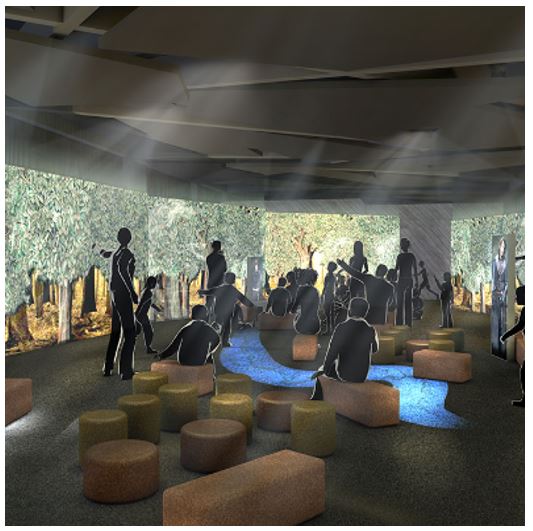
The Robin Hood Gallery providing an immersive, multi sensory experience, enabling visitors to travel back in time to medieval Nottingham
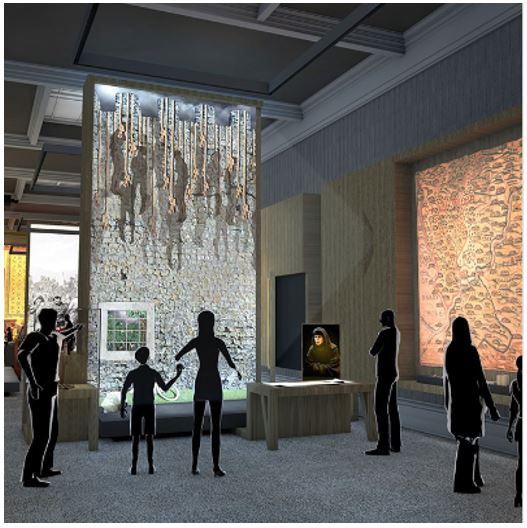
The Rebellion Gallery exploring the fight for democracy, representation and fairness which runs throughout Nottingham history. Enormous 5m x 3m video screens feature dramatic animations encompassing the noise and chaos created by Nottingham’s famously rebellious inhabitants during three key periods of history:
- English Civil War 1642-1644. Charles raised his standard at Nottingham, to declare war on Parliament, but wasn’t supported by the local people.
- Luddite uprising 1811-1817. People were hanged outside what is now the Galleries of Justice. In 1817 Jerimiah Brandreth (an ancestor of Writer and broadcaster, Gyles Brandreth) was hanged and drawn with the quartering being commuted.
- Parliamentary Reform 1830-1832. Nottingham’s notorious act of protest, lead to the castle being burnt down.
The Early Nottingham Craft Gallery showcasing 2 of the museum’s finest collections:
- Medieval Alabasters
- 17th Century Salt Glaze Pottery
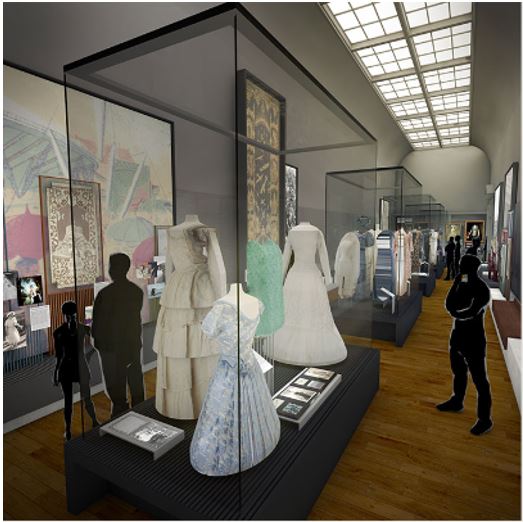
The Nottingham Lace Gallery dedicated to the story of Nottingham’s most famous creative industry. A catwalk of cases showing clothing made by machine with remarkable weave and weft. The lace panel was attached by hand taking 6 hours – and is 4m high.

Tours starting at Brewhouse Yard employ actors to act-out what life was like. One playing the part Frances Lee, wife of William Lee and described as like a medieval Barbara Windsor, really got into character by sprinkling lavender on the ground. When a dignitary from the Heritage Lottery Fund commented that it smelt nice, the reply came: “it covers the smell of p***!”
There are around 850 caves under Nottingham, many of which have been 3D scanned. You can view a fly-through on Nottingham Cave Survey on YouTube. Pre-Covid, headsets could be used to give visitors a virtual tour without actually having to go into the cave.
The famous Mortimer’s Hole passageway through the sandstone rock has been refurbished and now has lighting at floor level as well as a handrail at the side of the steps.
During questions after the talk, Cal confirmed the Military Museum is still housed in the castle.
A very interesting talk which left members wanting to visit when the castle re-opens – hopefully with lower admission prices!
Susan Bunting